TESTOSTERONE HEALTH
Testosterone replacement therapy (TRT) is available in several forms, including injections, gels, creams, patches, pellets, and other delivery systems. For men who prefer to avoid injections, topical testosterone can be an effective alternative.
But not all topical testosterone products behave the same way.
The formulation, concentration, application site, skin characteristics, dosing schedule, and individual absorption can all influence how much testosterone ultimately reaches the bloodstream.
This is particularly important when comparing FDA-approved testosterone gels with compounded testosterone creams.
At Valyr Health, we believe the goal of testosterone therapy should not simply be to prescribe a particular formulation. The goal should be to find a treatment strategy that provides an appropriate testosterone level, improves symptoms, is safe, and fits the patient’s lifestyle and preferences.
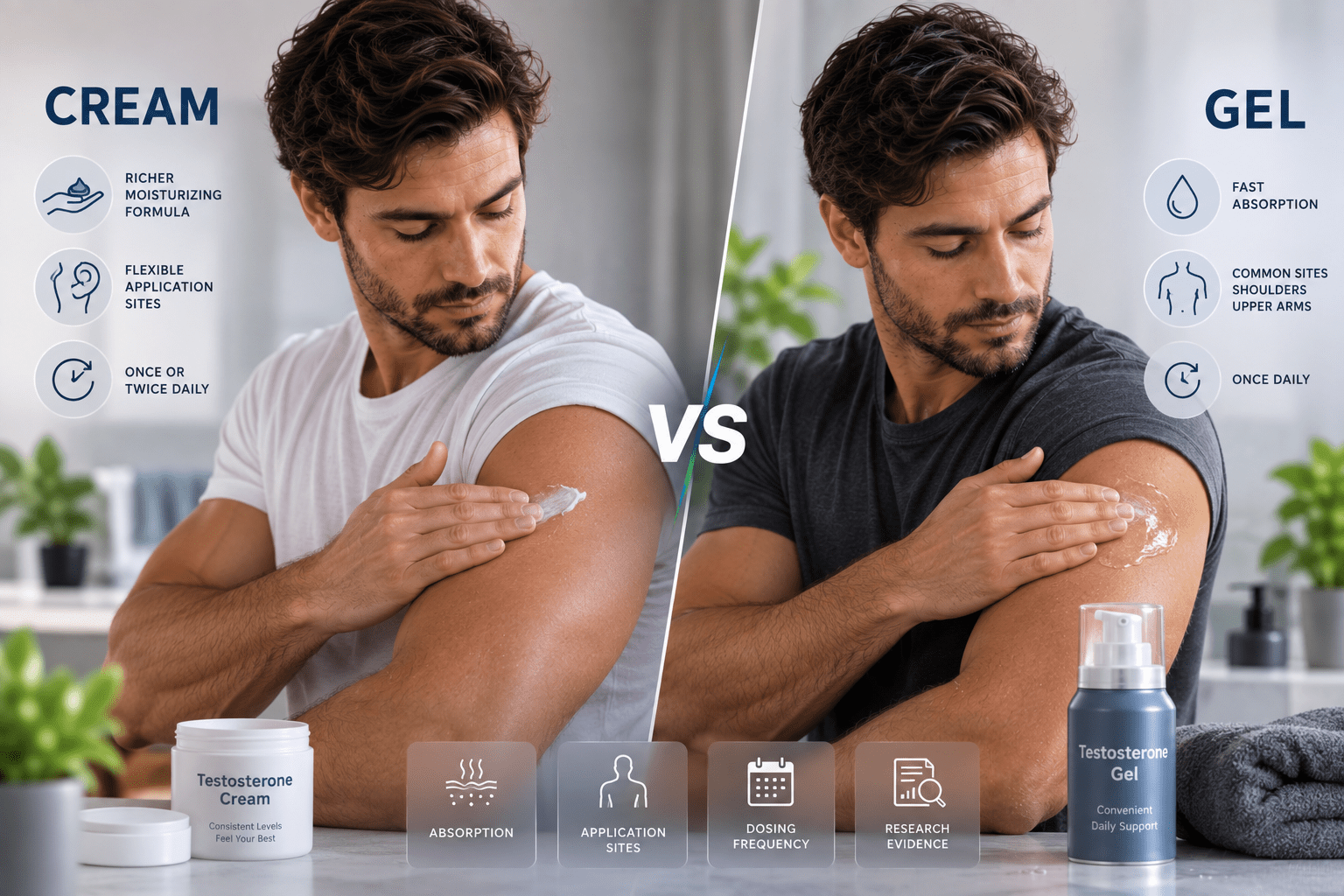
Testosterone Cream vs. Testosterone Gel: What's the Difference?
Both testosterone gels and testosterone creams are designed to deliver testosterone through the skin.
However, they are not necessarily interchangeable.
FDA-approved testosterone gels have undergone regulatory review for their specific formulations, dosing, manufacturing, pharmacokinetics, and approved uses.
Compounded testosterone creams, on the other hand, are customized formulations prepared by compounding pharmacies. Their concentration and vehicle can vary, and compounded medications do not undergo the same FDA premarket review for safety, efficacy, and consistency as FDA-approved products.
This does not mean a compounded testosterone cream cannot work.
It means that you cannot assume that a 100-mg dose of one topical formulation will result in the same blood testosterone level as 100 mg of another formulation.
The actual systemic exposure depends on the formulation and the individual.
How Much Testosterone Is Absorbed From Testosterone Gel?
One of the best-established examples is AndroGel 1%.
According to pharmacokinetic data, approximately 10% of the testosterone applied to the skin is absorbed into systemic circulation.
For example:
- 50 mg testosterone applied → approximately 5 mg systemically delivered
- 100 mg testosterone applied → approximately 10 mg systemically delivered
This does not mean that every testosterone gel delivers exactly 10% in every patient.
A clinical study of 227 hypogonadal men receiving a 1% testosterone gel found approximately 9–14% bioavailability after application to the upper arms, shoulders, and abdomen.
The FDA labeling similarly describes approximately 10% systemic absorption for AndroGel 1%.
Why is this important?
A topical testosterone prescription may contain substantially more testosterone than the amount that ultimately reaches the bloodstream.
The difference between the amount applied to the skin and the amount systemically absorbed is one reason topical testosterone doses should not be compared milligram-for-milligram with injectable testosterone.
What About Compounded Testosterone Cream?
This is where the answer becomes more complicated.
There is no single absorption percentage that applies to all compounded testosterone creams.
A compounded testosterone cream might be prepared at concentrations such as 5%, 10%, or another concentration, but concentration alone does not tell us what percentage will enter systemic circulation.
The absorption depends on factors including:
- Testosterone concentration
- Cream or gel vehicle
- Alcohol content
- Penetration enhancers
- Amount applied
- Application surface area
- Application location
- Skin thickness
- Skin hydration
- Individual skin permeability
- Time before washing
- Individual metabolism
This is why saying that “testosterone cream has X% absorption” is scientifically misleading unless the specific formulation has been studied.
A Study Comparing Testosterone Cream With Testosterone Gel
One of the more useful studies directly compared a 5% testosterone cream with a 1% testosterone gel in hypogonadal men.
The randomized crossover study included 16 men with androgen deficiency.
Participants received:
- 5% testosterone cream: 100 mg testosterone
- 1% testosterone gel: 50 mg testosterone
After 30 days of treatment, the researchers compared the pharmacokinetic profiles.
The results were striking.
The testosterone cream and gel were considered bioequivalent based on major pharmacokinetic measures.
The ratio of cream-to-gel exposure was:
- AUC: 0.99
- Cmax: 1.02
- Average testosterone concentration: 0.99
All fell within the predefined bioequivalence range of 80–125%.
The researchers reported average testosterone concentrations of approximately:
5% cream: 11.4 nmol/L
1% gel: 11.3 nmol/L
after 30 days.
What does this tell us?
It demonstrates that a higher-concentration testosterone cream can produce systemic exposure comparable to a lower-concentration testosterone gel when the specific formulations and doses are appropriately matched.
But it does not prove that every compounded testosterone cream has the same absorption.
The study evaluated a specific 5% cream formulation-not every compounded testosterone cream available from pharmacies.
This distinction is extremely important when discussing compounded testosterone therapy.
Why Can a 5% Cream Use Less Volume Than a 1% Gel?
The concentration is simply different.
For example:
1% testosterone gel
contains approximately:
10 mg testosterone per gram of gel
while:
5% testosterone cream
contains approximately:
50 mg testosterone per gram of cream
Therefore, a higher-concentration formulation allows the patient to apply substantially less product.
This can be appealing to men who dislike spreading a large quantity of gel over their skin every morning.
However, higher concentration does not automatically mean better absorption.
The vehicle and formulation determine how efficiently testosterone crosses the skin.
Does Where You Apply Testosterone Matter?
Yes-potentially quite a bit.
One of the most important findings from transdermal testosterone research is that application site can significantly influence systemic exposure.
The skin is not equally permeable everywhere on the body.
This means applying the exact same dose to different locations can produce different testosterone levels.
Testosterone Gel Absorption: Shoulders vs. Abdomen
A randomized crossover study involving 36 hypogonadal men investigated 1.62% testosterone gel applied to:
- Abdomen
- Upper arms/shoulders
- Both sites
The researchers found that testosterone bioavailability was approximately 30–40% lower when the gel was applied to the abdomen compared with the upper arms and shoulders.
Importantly, both locations were capable of producing testosterone levels in the normal range.
This demonstrates something clinically important:
A lower absorption site does not necessarily mean the treatment will fail. It may simply mean that the dose or formulation needs to be individualized.
What About the Arms, Shoulders, Chest, Abdomen, and Legs?
Another study evaluated Testim 1% gel applied to three different areas:
- Arms/shoulders
- Chest/abdomen
- Calves/legs
The highest testosterone concentrations occurred with arms/shoulder application.
The study found:
Arms/shoulders > chest/abdomen ≥ legs
in terms of testosterone levels achieved.
This reinforces the importance of following the application instructions for the specific product.
A patient should not assume that applying testosterone to a different body part will produce the same result.
What About Scrotal Testosterone?
The scrotal skin is dramatically different from typical trunk or arm skin.
It is considerably more permeable to testosterone.
Research has demonstrated that testosterone applied to scrotal skin can produce substantial systemic absorption with much smaller doses.
A multicenter study comparing scrotal and non-scrotal testosterone gel found that 1 gram of gel applied to scrotal skin produced treatment effects comparable to 5 grams applied to non-scrotal skin, suggesting substantially greater transdermal bioavailability through scrotal skin.
Another pharmacokinetic study evaluated testosterone cream applied directly to scrotal skin.
Testosterone levels rose rapidly, reaching peak concentrations approximately 1.9–2.8 hours after application, and the 25-mg dose maintained physiological testosterone concentrations for approximately 16 hours in the study population.
But there is an important warning.
Do not assume that an FDA-approved testosterone gel can be applied to the scrotum.
Many commercial testosterone gels specifically instruct patients not to apply the product to the genitals.
A compounded cream may have different instructions depending on its formulation.
The application site should therefore be determined by the specific prescription and clinician’s instructions, not by simply assuming that a more permeable location is better.
Testosterone Absorption by Application Site
The research can be summarized approximately as follows:
Application site
Relative absorption
Research finding
Scrotal skin
Very high
May provide several-fold greater bioavailability than conventional non-scrotal application
Upper arms/shoulders
High
Generally among the best non-scrotal sites
Chest/torso
Moderate
Can produce therapeutic levels
Abdomen
Moderate/lower
Approximately 30–40% lower bioavailability than arms/shoulders with 1.62% gel
Legs/calves
Lower in one study
Lower testosterone levels than arms/shoulders
Other sites
Variable
Depends heavily on product-specific instructions and formulation
These numbers should not be interpreted as universal absorption percentages.
They come from different formulations and studies, so they cannot simply be combined into one universal “absorption chart.”
Why Does Testosterone Absorption Vary So Much?
There are several reasons.
1. Skin thickness
Different areas of the body have different skin structures.
2. Blood flow
Blood flow beneath the skin influences how rapidly absorbed testosterone enters systemic circulation.
3. Skin permeability
Some areas are significantly more permeable than others.
4. Formulation
Alcohol-based gels, creams, solutions, and other vehicles behave differently.
5. Concentration
A 1% gel and a 5% cream are not directly interchangeable.
6. Application technique
Spreading the medication differently can change the effective surface area.
7. Washing
Bathing or showering too soon after application may affect exposure depending on the specific product.
For example, a randomized study of 1.62% testosterone gel found that washing the application site at two or six hours after application reduced AUC and average testosterone exposure by approximately 10–14%, whereas washing at 10 hours did not significantly affect exposure.
How Often Should Testosterone Gel or Cream Be Applied?
Most conventional testosterone gels are designed for once-daily application.
The goal is to create a relatively continuous testosterone exposure over approximately 24 hours.
A major pharmacokinetic study of 1% testosterone gel found that approximately 9–14% of applied testosterone became systemically available and that serum testosterone increased rapidly after application.
Another study found that once-daily 2% gel was capable of maintaining testosterone within the normal range for most men over a 24-hour period.
This is why standard testosterone gel therapy is generally prescribed once daily.
Does Testosterone Gel Actually Stay Constant for 24 Hours?
Not necessarily.
This is an important distinction.
Once-daily application is designed to provide exposure over the dosing interval, but it does not mean testosterone remains perfectly flat for 24 hours.
Pharmacokinetic studies show that testosterone levels rise after application and then decline before the next application.
Some men may therefore experience a meaningful difference between:
Peak testosterone after application
and
Trough testosterone immediately before the next application.
A review of testosterone pharmacokinetics notes that testosterone levels can fall below the normal range within 24 hours of topical application in some men, which is one reason daily administration is required.
Why Do Some Men Prefer Twice-Daily Testosterone Cream or Gel?
This is an increasingly interesting area of TRT practice.
Some men report that they feel better when their topical testosterone dose is divided into two applications per day, typically one in the morning and one later in the day.
The rationale is straightforward:
Instead of giving the entire daily dose at once:
100% of daily dose → morning
the same total daily amount can be divided:
50% → morning
50% → evening
The goal is to reduce the size of the peak after application and provide additional testosterone exposure later in the day.
However, it is important to distinguish patient preference and emerging clinical practice from established guideline recommendations.
New Research on Twice-Daily Testosterone Gel
A particularly relevant 2026 study evaluated men using 2% testosterone gel who changed from once-daily to twice-daily dosing while maintaining the same total daily dose.
The study included 12 patients.
Researchers compared testosterone concentrations at peak and immediately before the next dose.
They found that fractionated twice-daily dosing was associated with:
- Lower peak testosterone
- Higher trough testosterone
- Smaller peak-to-trough differences
- A greater proportion of patients reaching target testosterone concentrations at the measured peak
Specifically, median peak testosterone decreased from approximately 9.0 ng/mL to 5.7 ng/mL, while median nadir testosterone increased from approximately 1.4 ng/mL to 3.2 ng/mL.
Why does this matter?
It provides preliminary evidence for something some men have already experienced clinically:
Splitting the same daily topical testosterone dose into two applications may reduce peak-to-trough fluctuations.
However, this was a small retrospective study, and the authors appropriately characterized the findings as exploratory and hypothesis-generating.
It does not establish that twice-daily testosterone is superior for every patient.
Can Twice-Daily Testosterone Prevent a Daily Testosterone Drop?
It may reduce the size of the daily decline, but the wording matters.
The research does not prove that twice-daily dosing completely prevents a diurnal decline in testosterone.
What the 2026 study demonstrated was that dividing the same daily dose was associated with:
Lower peaks + higher troughs = smaller peak-to-trough difference.
For some men, that may translate into more consistent testosterone exposure and potentially fewer perceived fluctuations in symptoms.
For others, once-daily dosing may work extremely well.
Is Twice-Daily Testosterone FDA-Standard Dosing?
For conventional FDA-approved testosterone gels, once-daily administration is generally the standard labeled approach.
The decision to divide dosing should therefore be individualized and based on the specific product, formulation, prescription, and clinical circumstances.
This is particularly important because different topical products have different instructions regarding:
- Application site
- Amount applied
- Drying time
- Washing
- Skin contact
- Dosing frequency
A patient should not independently double the amount of testosterone they apply.
If a clinician decides to divide the daily dose, the goal is generally to divide the prescribed total daily dose, not increase the total amount of testosterone being administered.
Testosterone Cream vs. Gel: Once Daily or Twice Daily?
For topical testosterone, there are several possible approaches:
Once-daily
Advantages:
- Simple
- Convenient
- Consistent with most commercial gel labeling
- Easier adherence
- Less frequent application
Potential disadvantage:
- Some men may experience a noticeable peak-to-trough decline before the next dose.
Twice-daily
Potential advantages:
- Smaller individual doses
- Lower peak concentration
- Higher observed trough concentration
- Potentially more consistent exposure
Potential disadvantages:
- More complicated
- More opportunities to forget a dose
- More frequent skin application
- More opportunity for transfer to another person
- Less directly supported by large randomized clinical trials
The 2026 study provides promising preliminary evidence but is not sufficient to declare twice-daily dosing superior.
Testosterone Cream vs. Testosterone Gel: How Often Are They Used?
Both can be used daily.
However, compounded testosterone creams provide clinicians with more flexibility in concentration and volume.
For example, a pharmacy could compound a higher-concentration preparation that allows a smaller volume to be applied.
That does not automatically make the compounded product more effective.
The important question is:
What serum testosterone level does the individual actually achieve?
This is determined through appropriately timed laboratory testing.
Why Blood-Test Timing Matters With Topical Testosterone
Testosterone levels after topical administration change throughout the day.
Therefore, the timing of laboratory testing matters.
For commercial testosterone gels, some guidelines recommend measuring testosterone at a specified interval after application to determine whether the dose is adequate. The European Association of Urology, for example, notes that measurement approximately 2–4 hours after gel application can be used for dose optimization, while emphasizing the importance of consistent testing and avoiding contamination of the blood-draw site.
If someone is using a twice-daily regimen, interpretation becomes even more dependent on when the blood was drawn relative to each application.
This is another reason patients should tell their clinician exactly:
- When they applied testosterone
- Where they applied it
- How much they applied
- When the blood was drawn
Testosterone Cream vs. Gel vs. Injections
Topical testosterone is only one option.
Characteristic
Testosterone gel
Testosterone cream
Testosterone injection
Administration
Topical
Topical
Injection
Typical frequency
Daily
Usually daily
Variable
Absorption
Variable
Highly formulation-dependent
Not dependent on skin
Needles
No
No
Yes
Transfer risk
Yes
Potentially yes
No
Dose flexibility
Moderate
High with compounded formulations
High
Peak/trough variation
Usually relatively modest
Depends on formulation/frequency
Depends heavily on injection schedule
Application site matters
Yes
Yes
No
FDA-approved formulations
Yes
Depends on product
Yes
Need for monitoring
Yes
Yes
Yes
No single method is ideal for every patient.
Are Testosterone Creams Better Than Testosterone Gels?
Not necessarily.
A specific testosterone cream formulation can perform extremely well.
The 2016 randomized crossover study described above demonstrated that a 5% testosterone cream was pharmacokinetically bioequivalent to a 1% testosterone gel in hypogonadal men.
But this does not mean:
“All testosterone creams absorb better than gels.”
Nor does it mean:
“Compounded testosterone is stronger than FDA-approved testosterone.”
The evidence supports a much more nuanced conclusion:
The formulation matters more than the word “cream” or “gel.”
What About Compounded Testosterone Cream Specifically?
Compounded testosterone can be useful when a patient has a legitimate clinical reason for a customized formulation.
Potential advantages can include:
- Customized concentration
- Customized volume
- Potentially smaller application volume
- Flexibility in dosing
- Potentially lower cost
- Ability to customize the formulation when commercially available products are unsuitable
However, compounded testosterone also has limitations.
Because compounded products are not FDA-approved, there can be concerns regarding consistency, potency, and quality between formulations.
Recent expert recommendations specifically note published concerns regarding variability in testosterone concentrations in compounded testosterone products.
This is why laboratory monitoring is particularly important when using compounded topical testosterone.
Can Testosterone Cream Be Applied to the Scrotum?
This requires special attention.
Scrotal skin has unusually high testosterone permeability.
Research demonstrates that testosterone cream and gel can be absorbed very efficiently through the scrotal skin.
However, application site instructions are formulation-specific.
Some compounded testosterone creams are specifically designed for scrotal application.
Most conventional FDA-approved testosterone gels are not intended for scrotal use.
Therefore:
Never assume that a commercial testosterone gel can be substituted for a compounded scrotal testosterone cream-or vice versa.
Does Applying Testosterone to a Larger Area Increase Absorption?
Not necessarily by the amount you might expect.
A study examining 1% testosterone gel compared application to one site versus four sites.
Applying the gel to four times the skin area produced a testosterone AUC approximately 23% higher, although the difference did not reach statistical significance in the small study.
This suggests that simply spreading testosterone over a larger surface area does not necessarily produce a proportionally larger increase in systemic exposure.
Where the medication is applied may be more important than simply increasing the surface area.
Does Testosterone Cream or Gel Absorption Change With Exercise or Showering?
It can.
The amount of time testosterone remains on the skin can influence absorption.
In a randomized study of 1.62% testosterone gel, washing the application site at two or six hours reduced testosterone exposure by approximately 10–14%, while washing after 10 hours did not significantly alter exposure.
Patients should therefore follow the specific washing instructions for their product.
What About Testosterone Transfer to a Partner?
This is an important consideration with all topical testosterone products.
Testosterone remaining on the skin can potentially transfer to another person through direct skin contact.
A study evaluating 1.62% testosterone gel demonstrated measurable testosterone transfer to female partners after direct skin-to-skin contact, with transfer reduced by clothing or washing the application site.
This is particularly important when:
- Living with children
- Living with a pregnant partner
- Having frequent skin-to-skin contact
- Applying testosterone to areas that are likely to contact another person’s skin
Patients should follow the specific safety instructions for their product.
Which Topical Testosterone Application Site Is Best?
For FDA-approved products, the answer is:
Use the application site specified in the prescribing information.
Research suggests that, among common non-scrotal sites, the upper arms and shoulders can produce higher testosterone exposure than the abdomen with certain formulations.
But this does not mean that every testosterone product should be applied to the shoulders.
Different formulations have different instructions.
What Does the Research Tell Us About Testosterone Absorption?
The scientific literature supports several important conclusions.
1. Commercial testosterone gels have measurable but incomplete systemic absorption.
For AndroGel 1%, approximately 10% of applied testosterone reaches systemic circulation, with clinical pharmacokinetic studies reporting approximately 9–14% bioavailability.
2. There is no universal absorption percentage for compounded testosterone cream.
The formulation matters.
3. A specific 5% testosterone cream has demonstrated bioequivalence to a 1% gel.
The 2016 randomized crossover study found nearly identical AUC and average testosterone exposure between the studied cream and gel formulations.
4. Application site significantly affects absorption.
With 1.62% gel, abdominal application produced approximately 30–40% lower bioavailability than upper-arm/shoulder application.
5. Scrotal skin is substantially more permeable.
Research suggests substantially greater bioavailability from scrotal application compared with conventional non-scrotal sites.
6. Once-daily therapy is standard for most testosterone gels.
Daily administration is designed to maintain exposure throughout the dosing interval.
7. Some men may benefit from fractionating the daily dose.
A 2026 real-world study found that twice-daily fractionation reduced peak testosterone while increasing measured trough testosterone. However, the evidence remains preliminary.
Testosterone Cream vs. Gel: Which Is Right for You?
There isn’t one universally superior form of topical testosterone.
The best choice depends on:
- Testosterone level
- Symptoms
- Absorption
- Application site
- Skin characteristics
- Lifestyle
- Cost
- Convenience
- Fertility goals
- Risk of secondary exposure
- Preference for once- versus twice-daily administration
- Response to treatment
For some men, a standard once-daily FDA-approved gel works extremely well.
For another patient, a customized testosterone cream may provide a more convenient concentration or application volume.
And for another man, injections may be more practical because they eliminate the variability of transdermal absorption.
The Bottom Line
Testosterone gels and creams can both be effective forms of testosterone replacement therapy, but the amount of testosterone that reaches the bloodstream depends heavily on the specific formulation and how it is used.
FDA-approved testosterone gels such as AndroGel 1% have demonstrated approximately 9–14% systemic bioavailability, while a randomized study of a specific 5% testosterone cream found pharmacokinetic exposure essentially equivalent to a 1% testosterone gel.
Application site also matters. With 1.62% testosterone gel, upper-arm/shoulder application produced approximately 30–40% greater bioavailability than abdominal application, while scrotal skin can provide dramatically greater testosterone absorption than conventional non-scrotal skin.
Most testosterone gels are designed for once-daily dosing, but emerging research suggests that some men may experience a smaller peak-to-trough difference when the same total daily dose is divided into twice-daily applications. A 2026 exploratory study found lower peaks and higher troughs with fractionated dosing, although larger prospective trials are needed.
Ultimately, the most important question isn’t:
“Which testosterone formulation is strongest?”
It’s:
“Which formulation and dosing strategy provides this individual patient with an appropriate testosterone level, symptom improvement, safety, and a treatment routine they can consistently follow?”
At Valyr Health, testosterone therapy should be individualized around the patient-not simply around a particular medication or delivery method.
Frequently Asked Questions
Approximately 10% of the testosterone applied to the skin is systemically absorbed with AndroGel 1%. Clinical studies have reported approximately 9–14% bioavailability.
Not necessarily. Absorption depends on the formulation. A randomized study found a specific 5% testosterone cream to be bioequivalent to a 1% testosterone gel.
There is no universal percentage. Different compounded formulations can have substantially different pharmacokinetic properties, so blood testing is necessary to determine the individual’s response.
Yes. Research has demonstrated meaningful differences between application sites. For example, 1.62% gel produced approximately 30–40% lower bioavailability on the abdomen compared with the upper arms/shoulders.
Yes. Scrotal skin is highly permeable to testosterone. Studies have demonstrated substantially greater absorption than conventional non-scrotal application.
Not unless the specific product is designed and prescribed for that application site. Many FDA-approved testosterone gels specifically prohibit genital application.
Many topical testosterone preparations are used once daily, but dosing frequency depends on the formulation and prescription.
Some clinicians may divide a patient’s prescribed daily dose into two applications in selected circumstances. A 2026 exploratory study found that twice-daily fractionation reduced peak-to-trough differences while maintaining the same total daily dose.
Some men prefer twice-daily dosing because they perceive a drop in testosterone or symptoms before their next daily application. Emerging data suggest that splitting the daily dose can increase measured trough levels and decrease peak levels, potentially producing a more even exposure profile.
It does not have to. The studied fractionated approach used the same total daily dose, divided into two applications.
Topical testosterone can produce relatively steady exposure, but fluctuations still occur. Injection-related fluctuations depend heavily on the formulation and dosing interval.
There is no evidence that compounded testosterone is universally better. A specific compounded formulation may be appropriate for an individual patient, but compounded products can have greater variability in formulation and potency.
Scientific Sources and Further Reading
Scientific Sources
- Wang C, et al. Long-term pharmacokinetics of transdermal testosterone gel in hypogonadal men.
Journal of Clinical Endocrinology & Metabolism.
Demonstrated approximately 9–14% bioavailability with a 1% testosterone gel.
- Miller J, et al. Pharmacokinetics and relative bioavailability of absorbed testosterone after administration of a 1.62% testosterone gel to different application sites in men with hypogonadism.
Endocrine Practice. 2011.
Demonstrated approximately 30–40% lower bioavailability with abdominal versus upper-arm/shoulder application.
- Meikle AW, et al. Pharmacokinetics of transdermal testosterone gel in hypogonadal men: application of gel at one site versus four sites.
Demonstrated the effects of application surface area on testosterone exposure.
- Mazer NA, et al. Absorption of testosterone gel 1% from three different application sites.
Demonstrated differences in testosterone levels according to application location, with arms/shoulders producing the highest levels.
- Kühnert B, et al. Testosterone substitution with a new transdermal hydroalcoholic gel applied to scrotal or non-scrotal skin.
European Journal of Endocrinology. 2005.
Demonstrated substantially greater transdermal efficiency through scrotal skin.
- Iyer R, et al. Pharmacokinetics of testosterone cream applied to scrotal skin.
Andrology. 2017.
Examined dose-dependent absorption and pharmacokinetics of testosterone cream applied to scrotal skin.
- Wittert G, et al. An open-label, phase 2, randomized crossover bioequivalence study of AndroForte 5 testosterone cream and Testogel 1% testosterone gel.
Andrology. 2016.
Demonstrated pharmacokinetic bioequivalence between the studied 5% cream and 1% gel formulations.
- Meikle AW, et al. Transdermal testosterone gel: pharmacokinetics, efficacy of dosing and application site in hypogonadal men.
BJU International. 2004.
Evaluated once- and twice-daily gel regimens and application sites.
- Fractionated testosterone gel replacement therapy in clinical practice: a real-world exploratory clinical experience. 2026.
Evaluated once- versus twice-daily 2% testosterone gel using the same total daily dose.
- Effects of skin washing on systemic absorption of testosterone in hypogonadal males after administration of 1.62% testosterone gel.
Demonstrated the effect of washing on testosterone exposure.
- Effect of application site, clothing barrier, and application site washing on testosterone transfer with a 1.62% testosterone gel.
Examined secondary testosterone exposure following skin-to-skin contact.
Talk With Valyr Health
A qualified Valyr Health clinician can review your symptoms, laboratory results, medical history, and treatment goals to discuss appropriate next steps.