TESTOSTERONE & PERFORMANCE
Testosterone replacement therapy (TRT) is an established treatment for men with clinically diagnosed testosterone deficiency, also known as hypogonadism. When appropriately prescribed and monitored, TRT may help restore testosterone levels and improve certain symptoms associated with low testosterone—including changes in body composition, sexual function, energy, and, in some men, physical performance.
But there are many misconceptions about testosterone injections and muscle growth.
Does TRT make you stronger?
How much muscle can you gain on testosterone?
Does injecting testosterone into a particular muscle make that muscle bigger?
How long does it take to see results?
And is long-term testosterone replacement therapy safe?
At Valyr Health, we believe men considering TRT should understand both the potential benefits and the limitations of treatment.
TRT Can Support Progress, but It Is Not a Shortcut
Testosterone replacement therapy can correct a clinically diagnosed deficiency. Meaningful strength and muscle development still depend on resistance training, nutrition, sleep, recovery, genetics, age, and overall health.
Does TRT Increase Muscle Strength?
Research suggests that testosterone replacement therapy can improve muscle strength in some men with testosterone deficiency.
A 2023 systematic review and meta-analysis evaluated 13 studies involving more than 2,000 older men with low to low-normal testosterone levels. Researchers found that TRT was associated with improved muscle strength compared with placebo, with greater improvements generally seen in men who started treatment with lower testosterone levels.
Read the study on PubMed: Effects of Testosterone Replacement Therapy on Muscle Strength in Older Men with Low to Low-Normal Testosterone Levels
However, TRT does not affect every patient in exactly the same way.
Some men may experience meaningful improvements in strength and physical capacity, while others may notice greater changes in energy, libido, body composition, or general well-being.
Most importantly, TRT is not a substitute for resistance training.
Testosterone supports processes involved in maintaining muscle tissue, but building strength still requires an appropriate training stimulus.
How Much Muscle Can You Gain on TRT?
There is no universal amount of muscle that every man will gain from testosterone replacement therapy.
The results can depend on:
- Baseline testosterone levels
- Age
- Overall health
- Training history
- Resistance-training program
- Protein and calorie intake
- Sleep quality
- Body composition
- Treatment adherence
- Whether testosterone is maintained within an appropriate physiologic range
Clinical research indicates that testosterone therapy can increase lean body mass in appropriately selected men with testosterone deficiency. However, increases in muscle strength can be more variable.
This distinction is important.
Increasing lean body mass does not automatically mean an equivalent increase in functional strength.
Muscles still need progressive resistance training to become stronger.
TRT and Resistance Training Work Together
For men who have clinically diagnosed testosterone deficiency, TRT may provide a more favorable hormonal environment for maintaining or developing lean tissue.
Resistance training then provides the stimulus that tells the body to adapt.
Nutrition, adequate protein, recovery, and sleep are also important pieces of the equation.
At Valyr Health, we view testosterone replacement as one component of a broader approach to men’s health—not as a shortcut to bodybuilding results.
How Long Does It Take for TRT to Increase Muscle and Strength?
Testosterone replacement therapy does not produce immediate muscle growth.
The timeline varies considerably between individuals, but some changes may occur gradually over several months.
The First Several Weeks
Some men may notice improvements in symptoms such as energy, motivation, sexual function, or exercise consistency.
These early changes should not necessarily be interpreted as new muscle growth.
Three to Six Months
Changes in lean body mass, exercise recovery, and physical performance may become more noticeable in some patients.
The degree of improvement depends heavily on baseline testosterone levels, exercise, nutrition, sleep, age, and overall health.
Six to Twelve Months
Body-composition and strength-related changes may continue to develop.
Men who consistently participate in resistance training are more likely to see meaningful improvements in functional strength than men who remain sedentary.
Beyond One Year
TRT may help maintain the benefits associated with correcting testosterone deficiency, but muscle growth does not continue indefinitely simply because someone remains on testosterone.
Eventually, progress depends on the same fundamentals that affect everyone:
- Progressive resistance training
- Nutrition
- Recovery
- Sleep
- Genetics
- Age
- Overall health
TRT can correct a testosterone deficiency. It does not eliminate the body’s natural limitations.
Do Testosterone Injections Build Muscle at the Injection Site?
No.
There is no credible evidence that injecting testosterone into a particular muscle selectively causes that muscle to grow.
Testosterone is absorbed into the body and produces systemic effects. An injection into the glute, thigh, or another approved injection site is a method of medication delivery—not a targeted muscle-building technique.
For example, injecting testosterone into your shoulder will not specifically make your shoulder muscles larger.
Injection sites should be selected based on your prescribed medication, injection route, medication volume, needle size, technique, and clinician instructions—not based on which muscle you want to develop.
Can Scar Tissue From Testosterone Injections Make a Muscle Stronger?
No.
Scar tissue is not the same thing as healthy skeletal muscle.
Muscle adaptation from resistance training involves complex processes including muscle protein synthesis, cellular signaling, neuromuscular adaptation, and changes within muscle fibers.
Fibrotic scar tissue does not contract like normal skeletal muscle and should never be intentionally created as a strategy for increasing strength.
Repeatedly injecting the same location can potentially contribute to:
- Persistent tenderness
- Firm lumps or nodules
- Local irritation
- Thickened tissue
- Bruising
- Discomfort with future injections
- Difficulty administering subsequent injections
Rotating appropriate injection sites and following proper injection technique can help minimize these problems.
How Can You Reduce Testosterone Injection-Site Problems?
If you use injectable testosterone, follow the injection instructions provided by your healthcare professional.
General precautions include:
Rotate Appropriate Injection Sites
Avoid repeatedly injecting the exact same location.
Your healthcare provider can explain which injection sites are appropriate for your particular medication and injection route.
Use the Prescribed Needle and Injection Route
Testosterone may be administered intramuscularly or subcutaneously depending on the formulation and treatment plan.
Do not independently change your injection route, needle size, medication volume, or injection schedule.
Use Clean Injection Technique
Wash your hands, clean the medication vial and injection site as instructed, and use a new sterile needle and syringe for every injection.
Never share or reuse injection supplies.
Avoid Inflamed or Damaged Tissue
Do not inject into an area that is unusually painful, red, swollen, bruised, infected, or hardened unless specifically instructed by your healthcare professional.
Report Persistent Reactions
Contact your healthcare provider if injection-site pain, redness, warmth, swelling, drainage, or a lump persists or worsens.
Rapidly spreading redness, significant swelling, severe pain, or fever requires prompt medical evaluation.
Are Subcutaneous Testosterone Injections Effective?
For some men, subcutaneous testosterone injections can be an effective alternative to traditional intramuscular injections.
Subcutaneous injections deliver medication into the fatty tissue beneath the skin rather than deep into muscle.
Research has demonstrated that certain subcutaneous testosterone formulations can restore testosterone levels to the normal range in men with hypogonadism.
For example, a pilot study published in The Journal of Urology evaluated weekly subcutaneous testosterone enanthate and found that testosterone levels remained within the normal range in the patients studied.
Read the study on PubMed: Subcutaneous Administration of Testosterone
Additional research has evaluated weekly subcutaneous testosterone enanthate and found that the approach can provide sustained testosterone levels in appropriately selected men.
Read the PubMed study on subcutaneous testosterone enanthate
However, subcutaneous testosterone is not automatically the best option for every patient.
The appropriate treatment route depends on the medication, formulation, medical history, treatment goals, preferences, and response to therapy.
Is Long-Term Testosterone Replacement Therapy Safe?
TRT can be used long term when there is an appropriate medical indication and treatment is properly monitored.
Testosterone replacement therapy is not simply a treatment that can be started and ignored.
Because exogenous testosterone suppresses the body’s natural testosterone production, men considering TRT should understand that treatment may affect the body’s natural hormone production while therapy continues.
Long-term monitoring may include:
- Total testosterone
- Free testosterone when clinically appropriate
- Hemoglobin and hematocrit
- Blood pressure
- PSA when clinically appropriate
- Lipid and metabolic markers
- Treatment response
- Potential side effects
- Sleep apnea symptoms
- Fertility goals
- Prostate and urinary symptoms
Testosterone and Cardiovascular Health
Cardiovascular safety has been an important topic in discussions about TRT.
The large TRAVERSE randomized clinical trial evaluated more than 5,000 men with hypogonadism who had preexisting cardiovascular disease or an increased cardiovascular risk.
The study found that testosterone therapy was noninferior to placebo for major adverse cardiovascular events such as cardiovascular death, nonfatal heart attack, or nonfatal stroke in the population studied.
Read the TRAVERSE study on PubMed: Cardiovascular Safety of Testosterone-Replacement Therapy
Importantly, this does not mean testosterone therapy is risk-free.
The study reported higher rates of certain adverse events in the testosterone group, and testosterone treatment can increase blood pressure in some patients.
That is why appropriate patient selection and ongoing medical monitoring are important.
Does TRT Affect Fertility?
Yes. This is one of the most important considerations for men thinking about testosterone replacement therapy.
Exogenous testosterone can suppress the signals between the brain and testicles that are necessary for normal sperm production.
As a result, testosterone therapy can significantly reduce sperm production and may lead to temporary azoospermia, meaning no sperm are detected in the semen.
A recent review published in 2025 describes how exogenous testosterone suppresses gonadotropins and reduces intratesticular testosterone, consequently impairing sperm production.
Read the PubMed review: Testosterone Replacement Therapy and Spermatogenesis in Reproductive Age Men
Additional research has also documented the relationship between exogenous testosterone and male infertility.
Read the PubMed review: Exogenous Testosterone—A Preventable Cause of Male Infertility
Planning to Have Children?
If you want to have children now or in the future, tell your healthcare provider before starting TRT.
Testosterone replacement therapy should not be assumed to preserve fertility.
There are other medical approaches that may be considered in certain men who have testosterone deficiency and want to maintain fertility potential.
Read more on PubMed: Diagnosis and Treatment of Hypogonadism in Men Seeking to Preserve Fertility
The appropriate strategy depends on the underlying cause of testosterone deficiency and the individual’s reproductive goals.
What Are the Potential Side Effects of TRT?
Potential side effects and monitoring considerations associated with testosterone therapy can include:
- Elevated hematocrit or red blood cell concentration
- Increased blood pressure
- Acne or oily skin
- Reduced sperm production
- Testicular shrinkage
- Fluid retention
- Breast tenderness or enlargement
- Changes in mood or sleep
- Worsening of untreated obstructive sleep apnea
- Changes in prostate or urinary symptoms
- Injection-site irritation
The goal of testosterone therapy is not simply to increase testosterone as much as possible.
The goal is to appropriately treat testosterone deficiency while balancing potential benefits, risks, symptoms, laboratory values, and individual health goals.
Can Increasing Your Testosterone Dose Make You Stronger?
Not necessarily—and more testosterone is not automatically better.
Medical testosterone replacement therapy is intended to restore testosterone to an appropriate physiologic range in men with testosterone deficiency.
It is not intended to produce the supraphysiologic testosterone levels associated with nonmedical anabolic steroid use or bodybuilding cycles.
Increasing the dose unnecessarily can increase the risk of adverse effects, including:
- Elevated hematocrit
- Increased blood pressure
- Acne
- Mood changes
- Fluid retention
- Fertility suppression
- Estrogen-related symptoms
- Other cardiovascular and metabolic concerns
If you are not getting stronger while receiving TRT, increasing your testosterone dose should not automatically be the answer.
Training quality, protein intake, calorie intake, sleep, injuries, medication adherence, thyroid function, and other health conditions may be more important factors.
How to Get Better Strength Results While on TRT
If TRT is medically appropriate for you, think of it as one component of your overall health strategy.
1. Follow a Progressive Resistance Training Program
Muscle needs a consistent training stimulus.
Gradually increasing weight, repetitions, training volume, or exercise difficulty can help stimulate improvements in strength and muscle development.
2. Consume Adequate Protein
Protein provides the amino acids your body needs to repair and maintain muscle tissue.
Individual protein needs vary based on body size, activity level, health status, and goals.
3. Avoid Extreme Calorie Restriction
Aggressive dieting can negatively affect training performance and make it more difficult to maintain muscle mass.
If your goal is fat loss, a sustainable calorie deficit combined with adequate protein and resistance training is generally more appropriate than extreme restriction.
4. Prioritize Sleep
Sleep plays an important role in recovery, exercise performance, appetite regulation, and overall health.
If you have symptoms of obstructive sleep apnea, discuss them with a healthcare professional.
5. Track Performance
Don’t evaluate your progress solely by looking in the mirror.
Consider tracking:
- Strength on key exercises
- Repetitions
- Training volume
- Walking or exercise capacity
- Grip strength
- Waist circumference
- Body composition
- Everyday physical performance
6. Keep Your TRT Follow-Up Appointments
Regular follow-up allows your healthcare provider to evaluate symptoms, testosterone levels, laboratory markers, side effects, and overall response to treatment.
The Bottom Line: TRT and Muscle Strength
Testosterone replacement therapy can help appropriately diagnosed men with testosterone deficiency improve lean body mass and, in some cases, muscle strength.
However, TRT is not a shortcut to muscle growth.
The best results are generally achieved when medically appropriate testosterone therapy is combined with:
- Progressive resistance training
- Adequate protein
- Appropriate nutrition
- Quality sleep
- Consistent recovery
- Regular medical monitoring
Testosterone injections also do not selectively build the muscle where the injection is administered, and intentionally creating scar tissue does not make a muscle stronger.
Before starting testosterone replacement therapy, men should receive an appropriate medical evaluation that considers symptoms, testosterone testing, medical history, potential risks, fertility goals, and treatment expectations.
Frequently Asked Questions About TRT and Muscle Growth
TRT may help improve lean body mass and other aspects of physical function in men with testosterone deficiency, but it cannot replace resistance training.
Meaningful improvements in strength generally require a consistent exercise program.
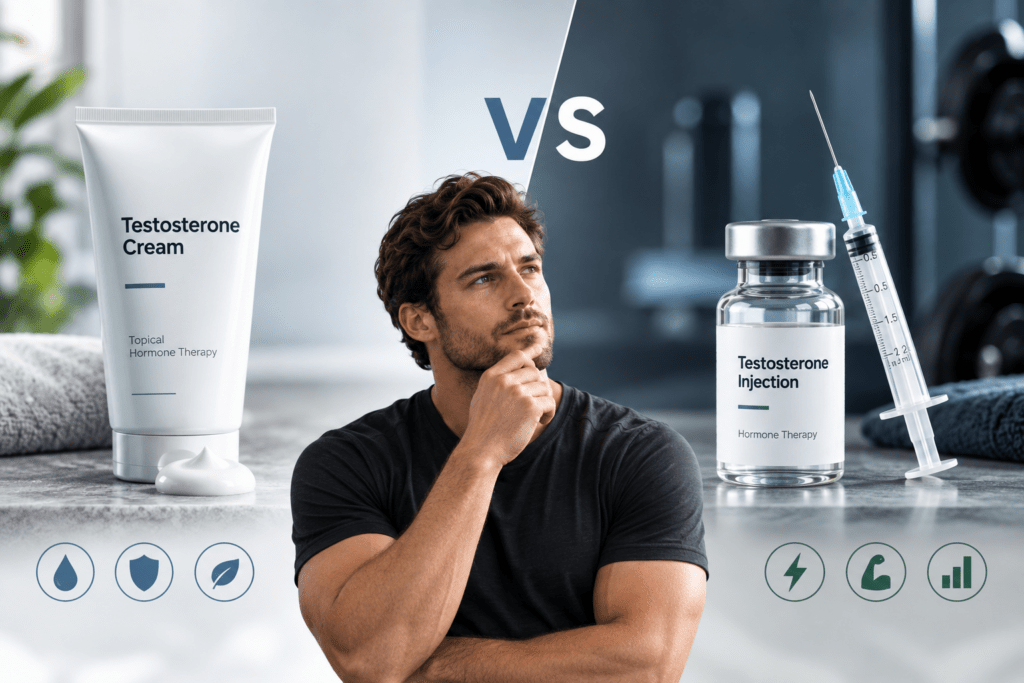
Both injections and topical testosterone can be used to restore testosterone levels in men with testosterone deficiency.
The best treatment depends on factors such as effectiveness, convenience, cost, adherence, side effects, treatment preferences, and medical considerations.
There is no universal testosterone delivery method that is best for every man.
TRT may help men with genuine testosterone deficiency maintain or regain lean mass.
However, testosterone replacement therapy should not be viewed as a general anti-aging treatment for otherwise healthy men with normal testosterone levels.
Not indefinitely.
Body-composition changes eventually reach a plateau, and continued progress depends on resistance training, nutrition, recovery, genetics, age, and overall health.
No.
Testosterone acts systemically after it is absorbed. Injecting testosterone into a particular muscle does not selectively cause that muscle to grow.
Serious injection-related complications are uncommon when medication is prescribed appropriately and injections are performed correctly.
However, repeated injections into the same location can contribute to irritation, tenderness, nodules, or tissue changes.
Persistent pain, redness, swelling, warmth, drainage, weakness, or fever should be evaluated by a healthcare professional.
Scientific References
- Effects of Testosterone Replacement Therapy on Muscle Strength in Older Men with Low to Low-Normal Testosterone Levels: A Systematic Review and Meta-Analysis.
PubMed
- Cardiovascular Safety of Testosterone-Replacement Therapy (TRAVERSE Trial).
PubMed
- Testosterone Replacement Therapy and Spermatogenesis in Reproductive Age Men.
PubMed
- Exogenous Testosterone: A Preventable Cause of Male Infertility.
PubMed
- Diagnosis and Treatment of Hypogonadism in Men Seeking to Preserve Fertility—What Are the Options?
PubMed
- Subcutaneous Administration of Testosterone: A Pilot Study Report.
PubMed
- A 52-Week Study of Dose-Adjusted Subcutaneous Testosterone Enanthate in Oil Self-Administered via Disposable Auto-Injector.
PubMed
- Management of Male Fertility in Hypogonadal Patients on Testosterone Replacement Therapy.
PubMed
This article is for educational purposes only and does not replace individualized medical advice. Testosterone is a prescription medication and should only be used under the supervision of a qualified healthcare professional.
Talk With Valyr Health About Testosterone Replacement Therapy
If you’re experiencing symptoms that may be associated with low testosterone—such as reduced energy, low libido, changes in body composition, decreased strength, or other concerns—Valyr Health can help you understand whether further evaluation for testosterone deficiency may be appropriate.
Our telemedicine approach makes it convenient to discuss your symptoms, laboratory results, treatment options, and ongoing monitoring with a qualified healthcare professional.
The goal isn’t simply to increase your testosterone. The goal is to help you achieve better health through appropriate, individualized care.
Schedule a consultation with Valyr Health today to learn more about testosterone replacement therapy and whether it may be appropriate for you.